
Father and Son
To Surf Alone - Chapter 7
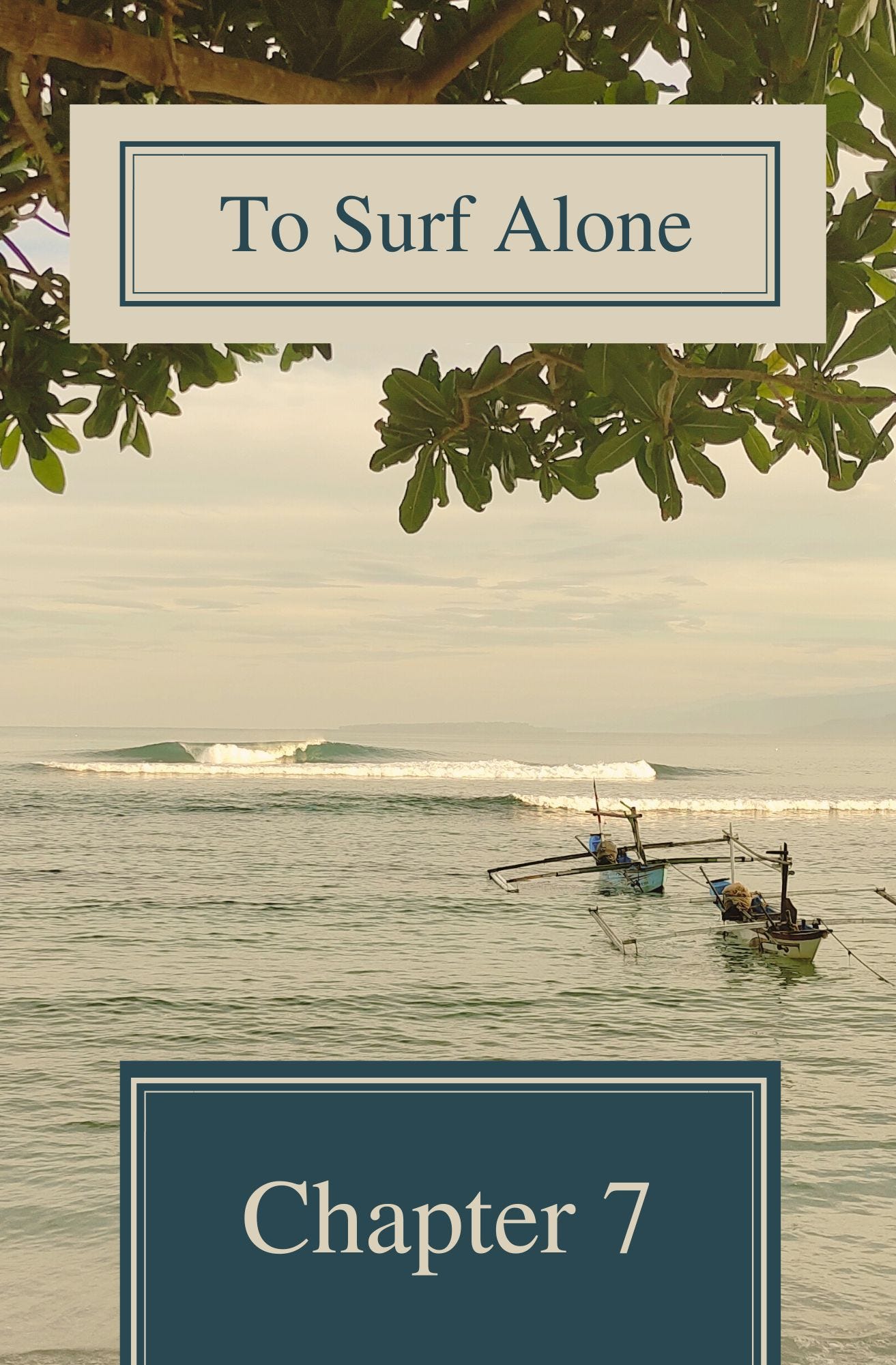
I wake up early the next morning, but my body is so sore and tired I can hardly move. I strain to get up and walk to the beach in front of our homestay. It’s a dark, windless morning with the overcast clouds reflected in the calm lagoon. And yet I know that just around the corner, there are big, scary waves. I think I’ll take the day off from surfing. My body needs to rest. I think I’ll spend the day with Arief and do some father-son bonding. That would be nice.
I wake Arief and we have some breakfast and just sit around relaxing and chatting. It’s nice to talk to him when he’s not absorbed in his phone. I guess it’s my fault just as much as it is his. I’m always busy doing something; I never just hang out with him. What is he supposed to do? Of course, he’s going to play on his phone. And then in the afternoon or night, when we are together, I’m playing on my phone too. So, it’s not like he’s the only one. Curse these damned phones, but they’re just so convenient. It’s weird to think that a tool which allows us to stay connected with family and friends thousands of miles away should create such distance between those who are closest to us.
“You want to go diving?” I ask
“Diving?”
“Yeah, we’ve got our swimming goggles, let’s go check out the reef in the front here. Do some diving.”
“But there’s rocks, and what about sea urchins?”
“Don’t worry, we have our goggles, we can see what’s going on. And if you see any urchins, just stay away from them. Come on, let’s go, it’ll be fun, maybe we can see some fish.”
We grab our goggles, and I bring my surfboard for Arief to hold on to since he’s not a very good swimmer. We wade into the water, it’s only about a metre deep, and pull on our goggles.
“I’ll hold the front and pull the board along,” I say. “You just hold the back, okay.”
“Okay.”
“Let’s go.”
I sink into the water, grab the nose of the board, and pull it along by kicking off the ground. Without a snorkel, it’s hard to appreciate what’s going on beneath the surface, as I have to constantly look up to breathe. And then on top of that, the goggles are misting up really quickly. I turn back to look at Arief and see him struggling at the back, his golden goggles flashing in the light.
“You okay back there?” I ask.
“It looks kinda scary, like an olden day movie,” he says, “everything is yellow.”
“Yeah sure, just hold on.” I laugh as I continue kicking us deeper. The further we move from shore, the clearer the water becomes, until we have about 3 – 5 metres of visibility. Not very clear by diving standards, but enough for us to see the bottom. It’s mostly sand and seagrass and small, unassuming fish.
We continue moving deeper, and the sand gradually makes way for rocks and crevices. Unfortunately, no coral is growing here, just dead rock. I spot a couple of purple surgeon fish and point them out to Arief, but by the time he looks, they’ve swam away. By now, the water is too deep for me to kick off the bottom, so I need to swim and pull the board behind me, which is no easy feat. Eventually, I just give up and drift with the current.
There are not a lot of fish, but we do spot the odd Damsel, Butterfly and Banner fish as we continue to drift with the current.
Suddenly, the water becomes murkier and deeper as we get pulled into a channel leading out of the lagoon. The bottom disappears into the deep green depths beneath us. At first, I think it might be a good idea to drift out, as there might be better visibility and bigger fish on the outside of the reef. Maybe even a few turtles. Then I hear Arief splashing and shouting behind me. He’s trying to say something, but he’s thrashing about so much his mouth fills with water, and he can’t get a word out.
“Hey, stop it, relax!” I shout at him. I pull the board closer and grab Arief by the arm, “Stop, struggling, just relax.”
He looks at me, his mouth agape as if on the verge of panic. “I don’t want to go deeper,” he nearly cries.
“We’re not going deeper, don’t worry. Just hold on, and we’ll go back.”
I aim us towards the side of the channel and kick and swim to get out of the current. With some effort, I manage to get us back into the lagoon where I can kick off the ground. The bottom here is once again sand and seaweed, and the occasional rocks.
As we’re swimming along, I spot a small eel. It is only about the size of a pencil, but it’s a good find since it’s so well camouflaged. I pull the board closer and point the eel out to Arief.
“Do you see it?” I ask.
“Yeah, it looks like a small snake. Is it dangerous?”
“Nah, it’s harmless.”
Now that I am no longer struggling with the surfboard and the current, but can easily push off the bottom, I start enjoying myself. The fact that the water is so shallow and there are so few fish makes it all the more exciting, since you really have to pay attention and look for the smaller things.
I see a small hole in the ground, that of a shrimp, and pull the board closer to show Arief. I break off a piece of seagrass and stuff it down the hole, then watch as the small shrimp comes pushing it back out.
I was hoping that it was the home of a pistol shrimp. They usually share their hole with a small goby fish. It would have been cool to show Arief. But it’s just a regular shrimp. I drop a few more stones into the hole and watch them getting pushed out again.
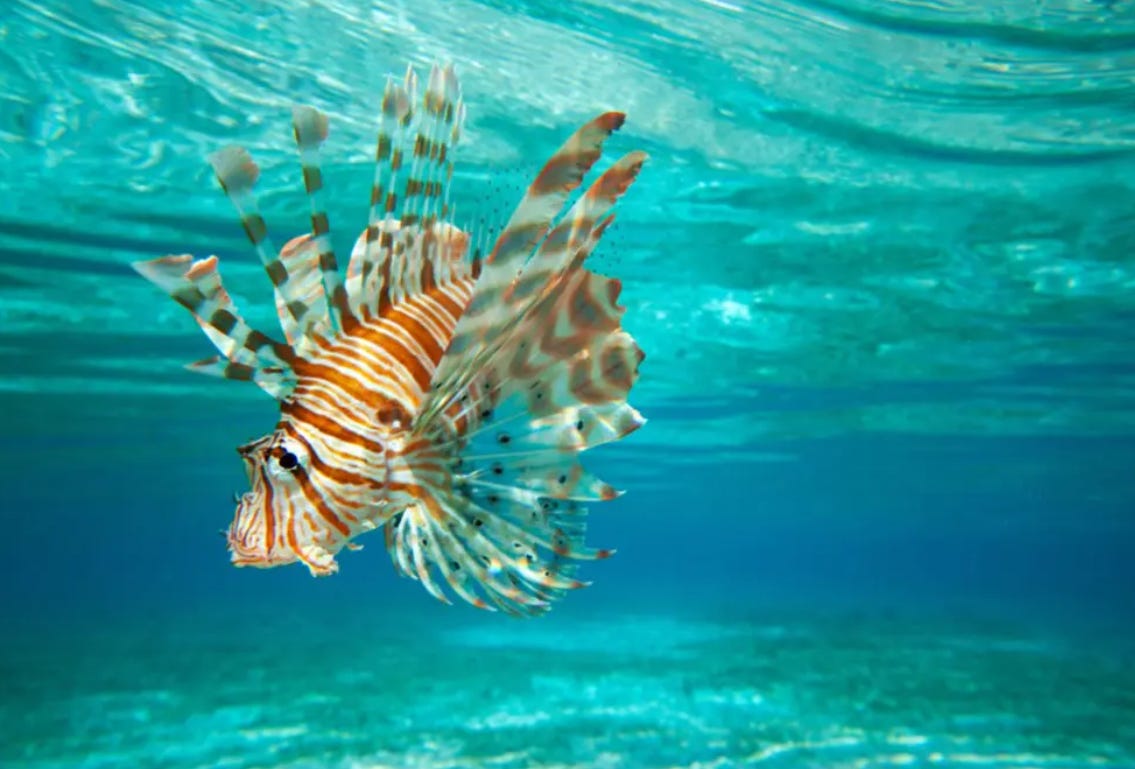
We continue drifting in the shallow water when we come across a collection of rocks and a solitary lionfish. Arief is still behind me and hasn’t seen the fish yet. I stop and stand up in the shallow water. Arief does the same.
“Hey listen,” I say, “there’s a lionfish over here by this rock.”
“What a lionfish! They’re dangerous, they can sting you!” he screams, looking around as if for an escape route.
“Relax man!” I say, feeling my anger rise. “Just relax, I’m going to show you where it is.”
“No, I don’t want to.”
“Stop it! Just relax.”
“But I’m scared, they can sting you.”
“There’s nothing to be scared of, it won’t attack you, the sting is a defence mechanism, it’s for defending itself, not attacking. Now put your goggles back on, and I’ll show you where it is.”
I push the surfboard out of the way and pull Arief closer towards me, then I point underwater towards the lionfish, close to the rock. It’s only a small lionfish, about 20cm long, but it’s a beautiful specimen, with its bold bands of white and red and its fanned-out fins with the pointy spikes at the end.
Once we’ve examined the lionfish, we continue moving along the shallow water when we come across about twenty sea urchins collected around each other. I pull the board closer so that Arief can have a look, but he lets go of the board and splashes frantically away. I wait for him to stop his thrashing about before saying, “Are you done? What are you scared of?”
“It’s sea urchins. I hate sea urchins.”
“They can’t do anything,” I say. “Unless you go and step right on top of it, it can’t hurt you. Just come here and have a look. And stop being so scared of everything.”
Slowly, he comes closer, and I reach out and carefully pick up one of the urchins, allowing it to rest in my palm.
“Doesn’t it hurt?” Arief asks.
“No, it’s ticklish.” I turn it over and show him, “See that, that’s the mouth, and look at all those hundreds of tiny feet. You can feel them when you hold it. It tickles, here take it.”
I place the urchin in his hand, and he holds it for a moment before dropping it back again.
“Ooh, it feels weird.”
“See, I told you it doesn’t hurt, it’s just ticklish.”
I want to tell him that we’re seeing a very special occurrence in the life cycle of sea urchins, that this is how they reproduce. The males and females gather and release hundreds of millions of sperm and egg cells into the water. The egg cells become fertilised and float around for a few days until microscopic larvae hatch and sink to the bottom, where they latch onto the rocks and eventually grow into little urchins themselves. I want to tell him that some species of urchins have a life span of more than 30 years.
But I don’t say anything, he wouldn’t find this type of thing interesting. So instead, I use a rock to break open a sea urchin and watch as dozens of small fish approach and start eating the remains of the urchin.
By now we’ve been in the water for about two hours, and although Arief is finally starting to enjoy himself and has gotten over his fear, I’m getting tired of pulling the board behind me.
“You can still swim and look around,” I say, starting to move away.
“What, where are you going, are you going back?” he asks, getting ready to follow me.
“No, I’m just tired, let me put the board on the beach, and we can still swim around a bit.”
Swimming in less than a metre of water, I push the board towards the shore. Right as I reach the beach, something catches my eye. It looks like it could be a rock, or perhaps a sponge, as it looks suspiciously soft. As I get closer, I start to get excited. Could it be a frog fish? That would be awesome to see one of the ocean’s craziest creatures. I’d love to show Arief.
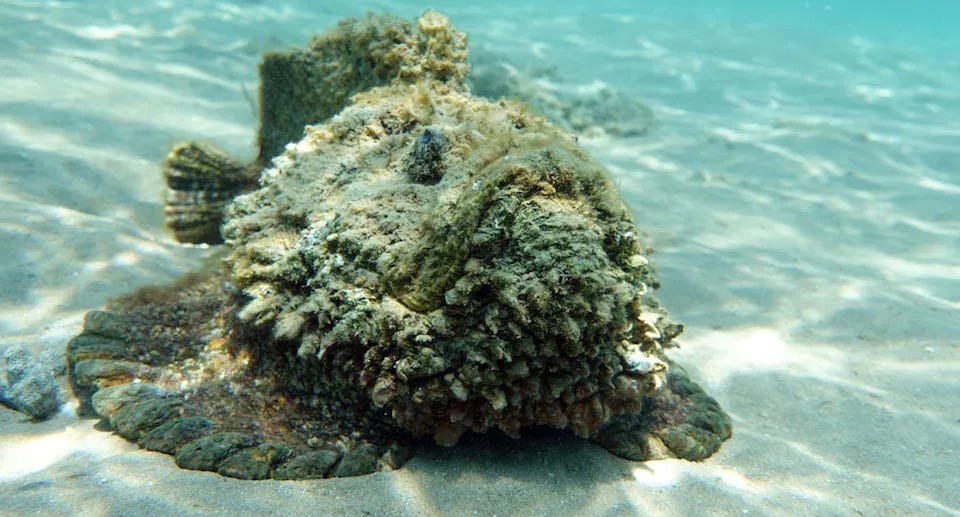
I find a sunken stick and poke at the object, revealing an ugly, upturned mouth and two angry, protruding eyes staring back at me. I gasp involuntarily, sucking in a mouthful of water and start coughing and spluttering. I can’t believe it. Could it be?
I sit up in the water, it’s barely waist deep, and I’m only a couple of metres from shore. This is exactly where we were swimming yesterday. I can’t believe it. After a few more coughs, I clear my throat and recover my breath. I stick my head underwater and have another look. There it is, it hasn’t moved an inch. This time, it’s clear to see. It’s a small Stonefish, lying on top of the sand.
I can’t believe it. I’ve never seen a Stonefish in my life. For a diver, this is like hitting the jackpot; seeing a Stonefish is very rare and sought after. I can’t believe my luck. And it’s right here, in the shallows, right where we swim.
And then it hits me, it’s right where we swim. The most venomous fish in the ocean, right where we swim. A single poke from one of its dorsal fins is enough to send you into a world of pain and, although it is extremely rare, could even cause death. And it’s right here by the shore, in less than two feet of water. Right where we swim.
I think about whether I should show Arief or not; he’s freaked out enough for today, and he’s finally starting to relax. This would only scare him again. And yet I can’t help myself, this is such a rare find, I have to share it with him. And warn him too.
“Arief,” I call, “get over here, come look at this.”
He comes running and jumping through the water, and as he does s,o I can’t help but wince.
“Be careful!” I shout. “Slow down. Now come here and come slowly, I want to show you something.”
He approaches and sits down next to me.
“I’m going to show you something now, but don’t freak out, okay.”
“What is it?”
“A Stonefish.”
“A Stonefish?”
“Yes, it’s the most venomous fish in the ocean.”
“More than the Lionfish?”
“Yes, much more, but don’t worry, it doesn’t attack. Put on your goggles and look, I’m going to poke it with this stick.”
“No, don’t.”
“It’s okay, it thinks we can’t see it. Anyway, I want to show you something. Look.”
We put our heads underwater, and there it is, unmoved and as still as ever. I poke it with the stick and turn it over on its side. It doesn’t even flinch and just allows me to push it. It looks like a piece of coral stone, right down to the rough texture and what appears to be actual algae growing on it. I push it some more, trying to coax it into swimming away, but it refuses to give up its cover and remains motionless.
Finally, I stand up and step out of the water. Arief follows me.
“Listen,” I say, “that is a Stonefish, the most venomous fish in the world. This one is only a baby, but even at that size, it can be very dangerous. If you step on it and its spines stick into your foot, it could be fatal. But even if it isn’t, you’ll experience the worst, most excruciating pain you can imagine. Do you understand?”
He nods, eyes round as saucers.
“And as you can see, it’s right here where we were swimming yesterday. Now, it’s okay; you don’t need to be scared. You just need to be careful, okay? When swimming, keep a lookout for any rocks or stuff, just to be safe. And also, did you see how the eyes pop out? That’s because these fish love to hide under the sand with only their eyes sticking out. So, you need to be careful of that too. When walking in the water, don’t just step down, you need to kind of shuffle your feet, like this.” I say, moving my feet from side to side. “You saw when I was poking it with a stick, it doesn’t even move. So just be careful. Anyway, I’m going back. If you want to swim some more, it’s okay.”
“No way!” he shouts, “I’m not swimming here ever again. Never!”
Previous: Chapter 6: Paddle Out At Ujung Bocor
Next: Chapter 8: Perfect Waves, Dry Eyes
If you enjoyed this post, please❤️, comment, share, or restack it. Every little bit helps.
Thank you.
Peace, Love, Faith and Grace.
Well done Rian! Ek glo mense sal meer respek hê vir die see as hulle meer weet van wat onder die water aangaan. Dit kan ń interessante stokperdjie wees, veral as mens 'n onderwater kamera het en die diere begin indentifiseer. As mens die diere beter verstaan sal mense beter weet oor hoe om agter hulle te kyk, maar ja.. dai stonefish is omtrent 'n ding, so het al die diertjies hul "super powers" om te oorleef. Geniet dit en jy sal sien dit gaan soos 'n "ripple effect" word..hy sal eendag sy maaitjes vertel van die ondervinding en so sal die woord versprei. Ek geniet om jou stories te lees :)